How a U.S. pillow brand scaled Pinterest to $600,232 in revenue — 22 months of compounding before the client pivoted to a different business.
A 22-month Pinterest build for a U.S. personalized pillow and home-décor gifting brand. $63,425 in spend. $600,232 in tracked revenue. 1,547 checkouts at a $388 average order value. Five of the top six campaigns returned 9.95×–11.72× ROAS. In April 2025 the client began pivoting from pillows to a broader accessories brand. By June 2025 the product catalog had fully changed. We stepped away in July 2025 — the engagement had outgrown our specialization.
9.46×ROAS
$600,232Pinterest revenue
$41.00CPA / checkout
$388.00Avg order value
How ROAS is measured
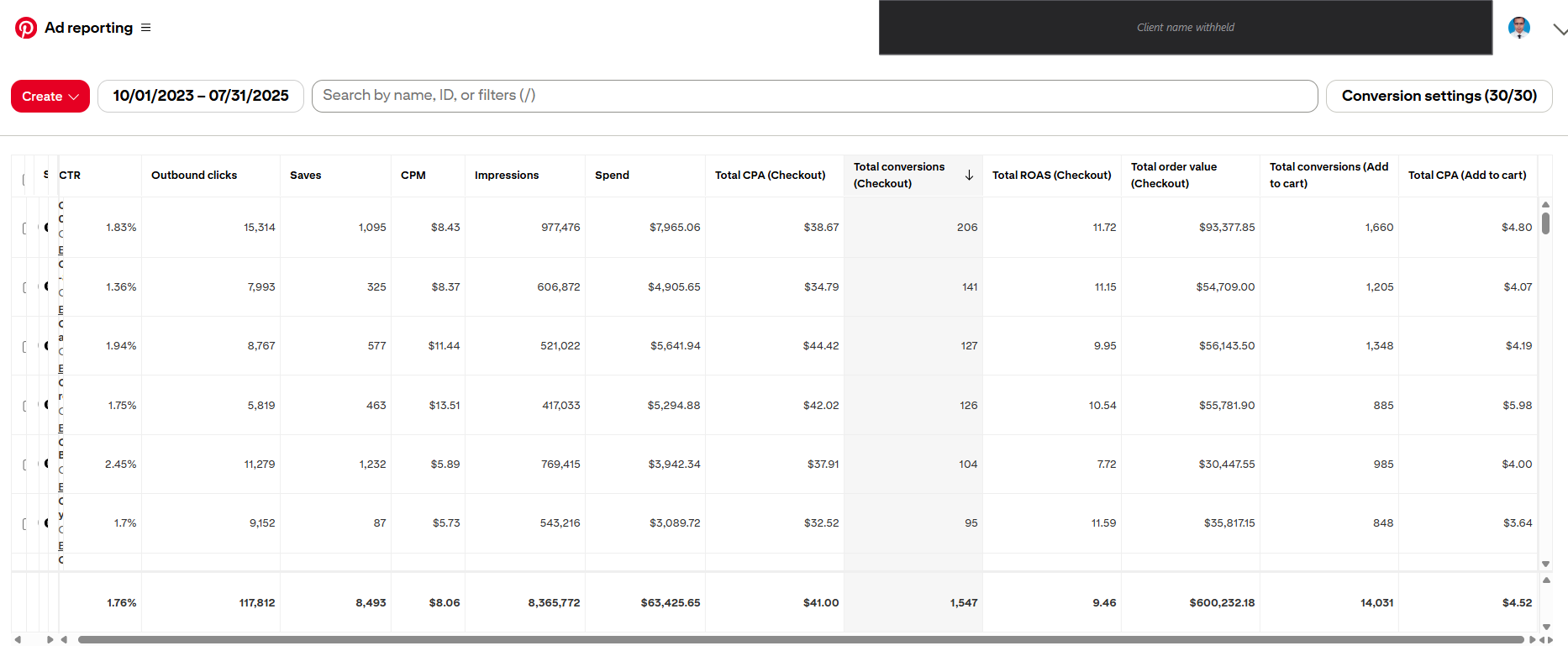
30/30 conversion window (30-day click, 30-day engagement). Pinterest Tag + Conversions API, deduplicated via event_id. Revenue = Shopify order value. Numbers match the Ads Manager screenshot on this page exactly.
Why the client name is withheld
At their request. Personalized-product brands compete in a copy-prone category. The numbers and screenshot are verbatim from Ads Manager. Full export available under NDA on request.
U.S. personalized pillow & home-décor brand · 22-month Pinterest ads engagement (Oct 2023 – Jul 2025) · client name withheld
The brief: turn Pinterest from a side channel into a two-year compounding engine.
The client is a U.S. brand selling personalized pillows and soft home-décor — the kind of product that lives at the intersection of home goods and gifting. AOVs are healthy ($387 average), the category is visual, and the customer base skews squarely Pinterest-native: women planning rooms, anniversaries, housewarming gifts, and small-business merch runs.
When the engagement started in mid-2023, Pinterest was already on the radar but had never been built out as a primary acquisition channel. The brand had tested Pinterest before, hit single-digit ROAS, and shelved it. The hypothesis worth proving: with the right funnel, this category should structurally outperform on Pinterest — saves should be high, cart values should be high, and a 21–30-day consideration window for personalized gifting should help, not hurt.
The brief was the opposite of “launch hard, capture quick.” It was: build for the long term. Let the algorithm learn. Run multiple campaigns in parallel without cannibalizing each other. And keep ROAS above a profitable floor for as long as the brand stayed focused on its core category.
Three reasons this category looks easy on paper and almost always fails in practice.
01
Six profitable campaigns is harder than one
Most accounts scale a single hero campaign until it breaks, then start over. Running six campaigns in parallel — each profitable, none cannibalizing the others — requires audience separation, creative differentiation, and a budget strategy that doesn’t let Pinterest’s auction collapse onto itself.
02
A 22-month attention span the algorithm rarely gets
Pinterest’s machine learning rewards accounts that feed it consistent, high-quality signal over long windows. Most performance teams give an account 60–90 days before declaring it “doesn’t work.” This brand committed to a long build — paired with a funnel that respects long consideration windows, that commitment unlocked compounding returns before the engagement concluded in July 2025.
03
A high cart-add count that’s a feature, not a leak
14,031 add-to-carts against 1,547 checkouts (11.0% cart-to-checkout) looks alarming if read the wrong way. But personalized-product accounts are built for high cart abandonment: customers configure, walk away to think about the recipient, and convert later. That gap is a retargeting goldmine — if the funnel is built to use it.
THE APPROACH
Six campaigns, four funnel stages, 22 months of compounding signal — and one very disciplined budget.
STAGE 01
Awareness with creative variance
Standard pins, Idea Pins and video pins targeting unbranded gifting and home-décor searches: “personalized pillow gift,” “anniversary gift home decor,” “linen sofa pillow ideas.” Each campaign targeted a slightly different audience cluster so Pinterest’s auction didn’t pit them against each other. Result: 8.37M impressions at a blended $8.06 CPM.
STAGE 02
Saves as primary signal
Personalized gifting is project-driven: the customer is planning a moment, not making an impulse buy. Saves tracked as a primary upstream KPI. Across 22 months: 8,493 saves — 5.5 saves per checkout. Each save became a retargeting seed and a lookalike-audience signal feeding Stage 04.
STAGE 03
Conversion via Performance+
Pinterest Performance+ Catalog Sales with Direct Links enabled, structured by product category and gifting occasion (anniversary / housewarming / wedding / personalized monogram). 30/30 conversion settings — because forcing a personalized-gift purchase into a 7-day window misses 40%+ of true revenue.
STAGE 04
Retention over 22 months
Retargeting at 7 / 30 / 90 days, abandoned-cart sequences, and customer-list lookalikes that grew more valuable every quarter. By month 18, lookalike audiences were the highest-ROAS segment in the account — an asset a 90-day account never gets to build.
PINTEREST TAG + CONVERSIONS API · SHOPIFY-NATIVE EVENTS · 30/30 CONVERSION WINDOW · DEDUPED VIA EVENT_ID · CUSTOMER-LIST LOOKALIKES REFRESHED QUARTERLY
Personalized-product accounts produce noisy attribution because customers configure, abandon, return, configure again, abandon again, and finally convert weeks later. Server-side tracking + 30/30 windows are what made the 9.46× number trustworthy — not an overcount, and not an undercount.
THE RESULTS · 22 MONTHS · OCT 2023 – JUL 2025
$63,425 in. $600,232 out. 9.46× back. 22 months of compounding.
$600,232
Pinterest-attributed revenue
over 22 months
9.46×
Total ROAS (Checkout)
on $63,425.65 spend
1,547
Checkouts
tracked via Pinterest Tag + CAPI
$388.00
Average order value
premium gifting category
14,031
Add-to-carts
11.9% click-to-cart rate
$41.00
CPA per checkout
10.6% of AOV — structurally efficient
$0.54
CPC outbound
within $0.50–$0.80 category benchmark
8.37M
Impressions
22 months of compound U.S. reach
TOP 6 CAMPAIGNS BY CONVERSIONS — FROM PINTEREST ADS MANAGER
“Five of the six top campaigns ran in a tight 9.95×–11.72× band for 22 months. The sixth reflects the brand’s H1 2025 category pivot — still profitable, but outside the pillow-specific optimisation range.”
Campaign
Spend
Revenue
ROAS
AOV
CPA
Top performer
$7,965
$93,378
11.72×
$453
$38.67
Catalog sales / awareness
$3,089
$35,817
11.59×
$377
$32.52
Cold prospecting
$4,905
$54,709
11.15×
$388
$34.79
Retargeting
$5,294
$55,782
10.54×
$443
$42.02
Lookalike expansion
$5,641
$56,143
9.95×
$442
$44.42
Accessories pivot (H1 2025)*
$3,942
$30,447
7.72×
$293
$37.91
Figures rounded to whole $. Top 6 campaigns by checkout volume shown. *The 7.72× campaign ran alongside the brand’s April 2025 category pivot to accessories — lower AOV ($293 vs $388–$453 in pillow campaigns) reflects the new product mix. All profitable.
FULL-FUNNEL PERFORMANCE WATERFALL
Impressions
8,365,772
Outbound clicks
117,812
1.76% click rate
Saves
8,493
5.5 saves per checkout
Add-to-carts
14,031
11.9% of clicks
Checkouts
1,547
11.0% of carts
Source: Pinterest Ads Manager · Oct 2023 – Jul 2025 · 30/30 conversion window · Conversions API deduped.
PINTEREST ADS MANAGER — FULL PERIOD SCREENSHOT
Account-level export: all campaigns, Oct 1 2023 – Jul 31 2025. Numbers visible in screenshot are the live Pinterest Ads Manager totals.
Screenshot taken Jul 2025. Account name redacted. Full export available under NDA on request.
Want results like these for your store?
Free 30-min audit. We review your current setup and show you the gap. No account access required.
“At a typical pillow / soft-goods gross margin of 45–65%, $600K of revenue translates to roughly $270K–$390K of gross profit. After the $63K in ad spend, that’s a profit-on-ad-spend (POAS) of 4.3×–6.2×.”
Margin assumption: 45–65% gross, in line with U.S. soft-goods and personalized-product benchmarks. Personalized products often run higher margins than commodity pillows because customization replaces inventory cost with on-demand production.
Five campaigns in a tight ROAS band — and what the sixth one tells you about how the engagement ended.
01
Five campaigns in a tight 9.95×–11.72× band is the rarest signal in performance marketing. Most multi-campaign Pinterest accounts have one or two stars carrying the average and several duds dragging it down. The core pillow campaigns in this account had every dollar earning its keep — no losers to cut, no heroes carrying the account. The sixth campaign (7.72×) came in during the brand’s April 2025 accessories pivot. It’s still profitable — but a lower AOV ($293 vs $388–$453) and weaker ROAS reflect a different category, not a breakdown of the Pinterest architecture.
02
8,493 saves over 22 months is a customer-data asset most brands never build. Pinterest saves don’t just signal interest — they’re a permission asset. Each save means a customer added this brand to a board they’ll revisit when the buying moment lands. In personalized gifting, that moment might be three weeks later, when the recipient’s birthday arrives. The 5.5-saves-per-checkout ratio means the majority of savers hadn’t converted yet when the engagement ended — future revenue sitting on Pinterest boards that the brand retained after our departure.
03
A $0.54 CPC against a $388 AOV is a leverage ratio almost no other channel offers. Pinterest CPCs in home-décor categories typically run $0.50–$0.80, so $0.54 is efficient-end-of-benchmark. But pair that CPC with a $387 AOV and the math becomes structurally favorable: a customer can browse 100+ pins’ worth of brand impressions for less than $60 of ad cost, and a single conversion pays for that 100+ impressions of brand-building 5×+ over.
04
A trained 22-month account is a defensible moat — even after the engagement ends. Competitors can copy a winning ad. They cannot copy a 22-month-trained audience structure: the retargeting pools, the lookalike seeds, the algorithm signal. When the engagement concluded in July 2025, the account held an asset that took 22 months to build. The brand owned that asset going forward, regardless of what agency managed it next.
WHY THE ENGAGEMENT ENDED — FULL TRANSPARENCY
The brand worked. The system worked. Then the brand changed into something different.
APR 2025
The client began pivoting from personalized pillows to a broader home-décor accessories brand. New product categories started appearing in the catalog: candles, throws, decorative objects, gifts outside the pillow-and-soft-goods range we had been optimizing for 20+ months. Performance on the core pillow campaigns remained strong — that’s the 9.95×–11.72× data in the table above — but the direction of the business was clearly changing.
JUN 2025
By June 2025, the brand had fully converted to a home-décor accessories brand. The product catalog had largely moved away from personalized pillows. The new categories — broader accessories, lifestyle goods — fell outside our specialization. We do not manage Pinterest Ads for general-merchandise home-décor brands; our edge is specifically in categories we understand deeply: pillows, tile, lighting, rugs, wall décor, furniture. The new scope of this brand no longer fit that mandate.
JUL 2025
We stepped away in July 2025. This was a clean professional decision, not a performance failure. The account we handed back had 22 months of audience data, trained lookalike pools, a functioning four-stage funnel, and a campaign architecture that worked. Any Pinterest specialist with accessories-brand experience could continue from where we left. The numbers in this case study reflect the pillow phase — the category we built, and the results we can fully stand behind.
WHAT THIS MEANS FOR YOUR STORE
If you’ve tried Pinterest for 60 days and walked away — this case is the answer to why it didn’t work.
The single most common Pinterest objection we hear: “We tested it for two months and it didn’t perform.” Two months is exactly the wrong window. Pinterest’s algorithm needs feedback loops; the buyer’s category-purchase cycle for home décor or gifting is 21–30 days minimum; and lookalike audiences only become valuable after a few hundred conversions feed them. Quitting at month 2 is quitting just before the compounding kicks in.
This pillow account proves the alternative. $2,883/month average spend over 22 months — a budget reachable for almost any independent home-décor brand. Multiple campaigns running in parallel by month 18, all profitable, all building the next quarter’s lookalike audiences. Retargeting and lookalike segments were the most efficient audiences in the account — assets that simply do not exist in a 60-day test.
Whether you sell pillows, rugs, lighting, tile, furniture, wall décor, or any other home-décor category, the architecture is the same. What changes is the creative and the keyword clusters. What doesn’t change is the patience required to let Pinterest do what it’s actually good at: compounding.
30-min audit. Zero pressure. We’ll tell you whether your account has a 60-day problem or a 2-year opportunity.
At their request. Personalized-product brands compete in a copy-prone category — competitors will reverse-engineer winning Pinterest creative within weeks of seeing it. The numbers, screenshots, and methodology on this page are exactly as reported in Pinterest Ads Manager. Available for verification on request under NDA.
Does this work for non-personalized products?
Yes — the structure works for any home-décor category. Personalized products amplify a couple of dynamics (high cart-add volume, longer consideration windows for gifting) but the four-stage funnel — Awareness → Saves-as-signal → Performance+ Conversion → Retention — is identical for rugs, tile, lighting, furniture, or wall décor.
How is this different from your other case studies?
This is the longest-running and highest-spend case in the portfolio. A U.S. tile retailer (14.93×) proves Pinterest works at $1K/month over 19 months. The European wall décor case (14.82×) proves it works at €3K/month at premium AOV. This pillow case is the proof that an account can run six campaigns in parallel, sustain a tight ROAS band (9.95×–11.72×), and compound over 22 months. Together the three cases cover budget range, geography, AOV, and time horizon.
What if I can’t commit to 22+ months?
You don’t have to commit upfront to any long window. You commit to a 30-day pilot. If the pilot hits benchmark ROAS, we move to a month-to-month retainer with no long-term contract. The pillow brand case is what’s possible when an account is allowed to mature — but the relationship structure is the same low-friction one we offer every client.
Used by furniture, lighting, rug, tile and decor brands across the U.S., U.K., Canada and Europe.
All metrics sourced directly from Pinterest Ads Manager reporting for the client account, reporting window October 1, 2023 – July 31, 2025. Conversion settings 30/30 (30-day click, 30-day engagement). Reporting screenshots available under NDA on request. Client name withheld at client request.